Out-of-band management was originally designed around a fairly simple operating model. Infrastructure lived in a small number of data centers, network teams had direct knowledge of the physical environment, and recovery usually meant opening a console session to a failed router, switch, firewall, or server.
That model is important, but it no longer reflects how most infrastructure is deployed.
Today, critical systems are distributed across branch offices, edge locations, manufacturing sites, retail environments, colocation facilities, cloud-connected campuses, and remote deployments with little or no local technical support. As the number of sites grows, the out-of-band conversation changes. The problem is no longer just how to reach a device. The problem is how to maintain operational control across hundreds or thousands of independent failure domains.
Every Remote Site Is Its Own Failure Domain
A distributed environment introduces operational risk at every location.
Each site may have a different WAN provider, power configuration, firewall policy, hardware lifecycle, and local support capability. Some locations may have redundant connectivity. Others may depend on a single broadband circuit or cellular connection. Devices may be installed in a secure data room, a branch closet, a roadside cabinet, or an industrial facility hundreds of miles from the nearest engineer.
In this model, a site outage is not just a connectivity problem. It can become a visibility problem, an identity problem, and a recovery problem at the same time.
When the production network is unavailable, the management path must remain independent of the same infrastructure that failed. If access depends on the primary WAN, the production firewall, or the same routing stack being investigated, the recovery architecture has inherited the failure.
Modern OOB must therefore be designed as a separate management plane, not merely another interface on the production network.
Console Access Is Necessary, but It Is Not Sufficient
Serial console access remains one of the most reliable methods for recovering network infrastructure. It provides device-level access even when the operating system, routing table, or production interface is misconfigured or the subject of a rogue update.
Console access by itself provides limited operational context. An engineer may be able to reach a router while still lacking answers to basic questions:
- Which services are affected?
- Is the issue isolated to one device or the entire site?
- Is the alternate network path available?
- Which firmware, warranty, or subscription applies to the device?
- Who last changed the configuration?
- Are similar failures occurring at other locations?
At scale, these questions cannot be answered through isolated console servers and spreadsheets. They require centralized telemetry, asset context, identity control, and a consistent operational model.
The value of OOB increasingly comes from the relationship between access and information. Access enables action. Visibility determines whether that action is fast, accurate, and repeatable.
Centralized Management Becomes the Control Layer
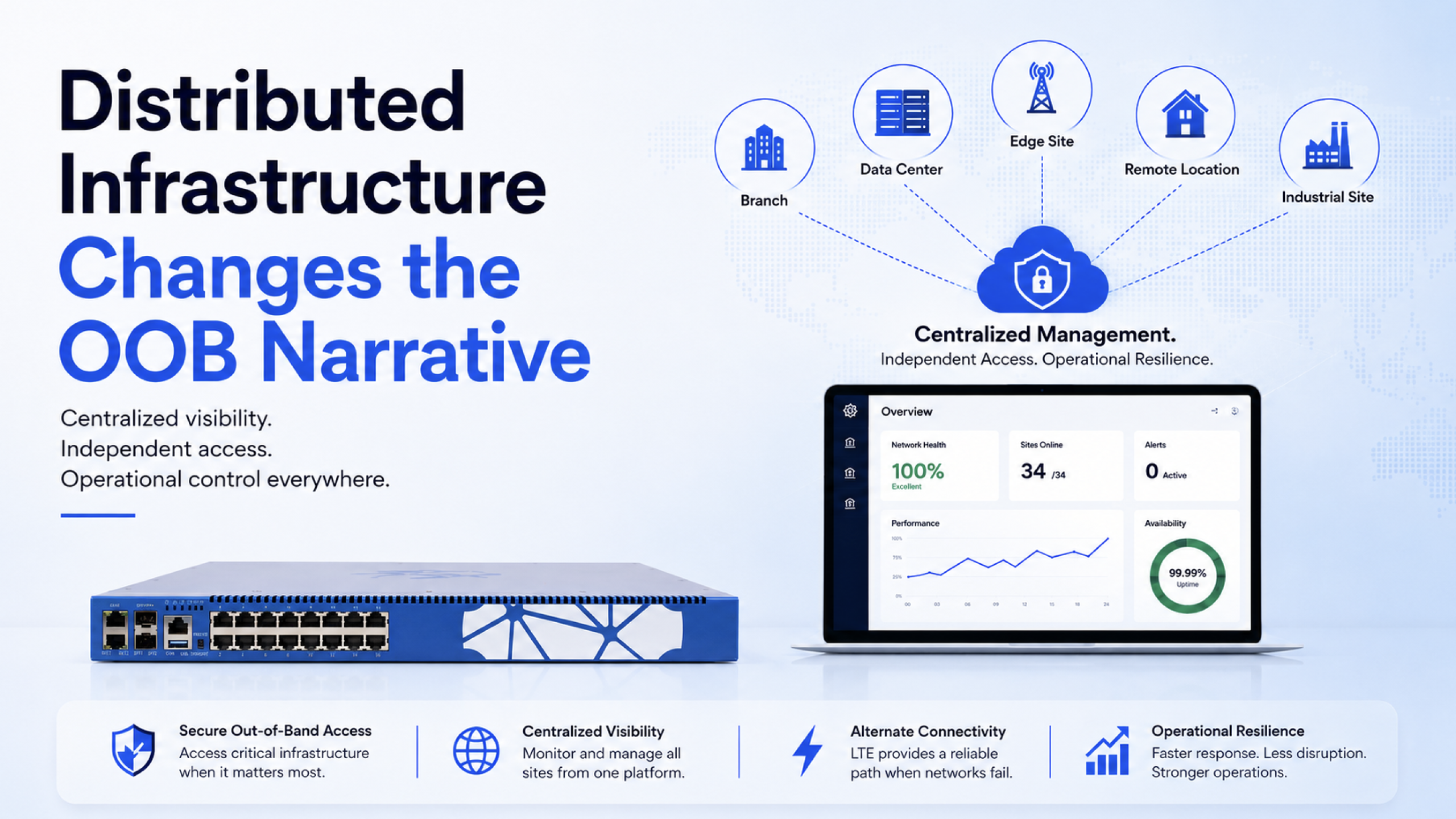
Distributed infrastructure requires a centralized control layer that can organize sites, devices, users, subscriptions, and operational status.
This does not mean every function must depend on the cloud. The out-of-band path must continue to operate when the production environment is impaired. It does mean that teams need a consolidated way to understand the environment before they initiate recovery.
A modern cloud management platform should provide:
- site and device inventory
- health and availability status
- identity and access controls
- asset and lifecycle records
- alerting and event visibility
- subscription and warranty information
- standardized access across distributed locations
Without that layer, every outage becomes a manual investigation. Engineers spend time locating credentials, confirming device details, contacting site personnel, and reconstructing the environment before troubleshooting can begin.
Centralized management reduces that delay by providing the context required to move directly from detection to diagnosis.
Alternate Connectivity Is Part of the Architecture
Distributed sites also change the role of cellular connectivity.
LTE should not be treated only as an emergency convenience. In many environments, it is a fundamental component of the recovery architecture. A cellular path can provide independent access when the primary WAN is unavailable, misconfigured, or affected by a carrier outage.
The key word is independent.
An alternate connection is only valuable if it bypasses the production failure. The management path should remain reachable without depending on the same firewall rules, routing tables, or upstream circuits that are currently unavailable.
For remote environments, this can mean the difference between restoring service in minutes or waiting while a technician is dispatched to the site.
OOB Is Now an Operational Resilience Platform
Distributed infrastructure changes OOB from a device-access function into an operational resilience capability.
The modern requirement is not simply to open a console. It is to preserve a secure management path, maintain visibility across locations, enforce identity controls, access the correct asset information, and recover without unnecessary physical intervention.
Gearlinx was designed around this model. By combining secure out-of-band access, centralized cloud management, alternate connectivity, and lifecycle visibility, the platform helps teams manage distributed infrastructure as one operational environment rather than a collection of isolated devices.
As infrastructure continues to move outward, the OOB architecture must move forward with it.
The question is no longer, “Can I connect to the device?” The better question is, “Can I maintain control of the environment when the production network cannot?”