
Education is Essential. Network Resilience is Smart.
Technology is becoming ever-more core to the educational experience, with teachers and students relying on rich media, deep data and analytics, and cloud delivery to drive better educational outcomes. Education has a specific set of requirements for IT that differentiate it from other verticals.
Network Resilience and all-day computing are required, as is the massive scale of students and teachers needing to work simultaneously. Security is paramount and increasingly, the delivery of rich media experiences puts additional pressure on the network to deliver a great educational experience.
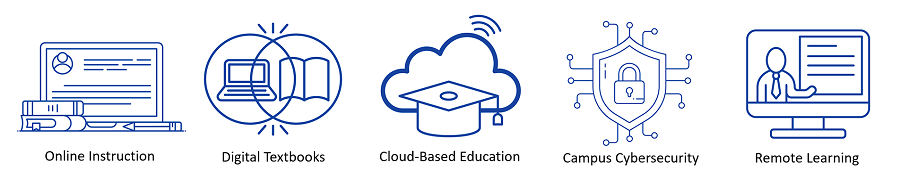
The current global trends in education have transitioned to digital learning environments, reflecting the need to think in multiple dimensions about how, when, and where learning takes place. These changes include not only new additions to classroom technologies but also those that enable this level of flexibility required to deliver instruction under nearly any conditions.
Transforming Classrooms and Campuses
Higher education leaders are continuing to invest in transforming classrooms, facilities, and campuses to build resiliency capabilities in the face of natural disasters, health and safety, and business disruptions. They are seeking to transform their institutions into smart campuses that are resilient, sustainable, operationally efficient, physically and digitally secure. The goal is a campus experience that is seamless, personalized, connected, flexible, and secure.
A critical component to the educational experience is a resilient network to support educational engagement through gamification (game-based learning), immersive experiential learning, and digital books. These require adequate infrastructure to support Augmented Reality (AR), Virtual Reality (VR), Mixed Reality (MR) and 5G speeds which places significant stress on the network. The Gearlinx™ Network Resilience Platform and Duckfone™ provide the assurance of network availability for the learning experience to occur and deepen the overall experience for students.
Security and remote learning is everywhere
Tight security is a prerequisite for any technology to be considered within the education sector. It’s vital to encrypt data in transit and at rest, protect ingress and egress traffic, and only adopt solutions that meet or exceed security requirements. As smart environments grow, so do the number of endpoints and the risk of compromise. Multifactor authentication, endpoint detection and response, and identity and access management all play a role in smart campus protection.
Remote first is the norm today in education with 40% of institutions adopting a hybrid-first approach to operations and service delivery. This is driven mostly by a higher demand for flexible learning options among students and lifelong learners. Virtual instruction, interactive flat panels, communication platforms are now baked into the curriculum at K-12 and higher education.
The use of cloud technologies in the educational process is becoming more and more popular opening many opportunities for educational institutions, teachers, and students. Educational-oriented SaaS cloud technologies such as Google Classroom, Blackboard, Knowledge Matters, Coursera, and Microsoft Education Center provides easy access to teaching tools without the need for expensive hardware, software, and textbooks.
The network can make or break modern learning experiences
While specific requirements will vary from school to school, the network is a key enabler of modern education. In a world of online classes and blended learning, students and teachers pay the price if network resources aren’t available (or can’t meet performance requirements).
To ensure the network is up to par, IT needs to invest in network resilience solutions, network security, visibility, and proactive performance monitoring and alerting. Even when you get capacity management and network design right, bottlenecks and performance issues can occur. The right network resilience tools can help you drill down and quickly assess and correct minor issues before they have a significant impact on learners.
The Gearlinx™ Network Resilience Platform is an essential solution for ensuring a flexible learning environment, resilient campus network, and a reliable remote learning experience. The Duckfone™ can connect and enable Internet of Things (IoT) on campuses including sensors, cameras, card readers, ID badges, biometrics, kiosks, automated attendance recording, and more.
Simplify cost management with Operational Resilience as a Service™
The ZERO Operational Resilience as a Service™ platform simplifies network resilience and cost management for education to streamline their operations and reduce costs. The service is based on a subscription model, and it includes features such as network management, monitoring and reporting, incident management, and IT service management. By using the Gearlinx™ ZERO platform, educational institutions can improve their operational efficiency and reduce costs associated with managing and maintaining their IT systems.
The ZERO cloud front-end gives you access to manage your endpoints, subscriptions, and infrastructure from anywhere, at any time. No longer will education have to buy bundled software nodes from vendors who make as much money from the nodes you don’t use, than the ones purchased for use. With Gearlinx™ ZERO, operational resilience is simplified by providing real-time visibility to manage devices, subscriptions, serial numbers, and warranty information so you buy what you need, when you need it.
With Gearlinx™, K-12 and higher education can lower CAPEX spending by 40%, improve free cash flow, and transition their business and network resilience to an OPEX model. Now that is Smart!
Keep teaching. Network uptime is our job.
With the right technology solutions in place, that allow for consistency and resilience to computing on and off-campus, students will be able to enjoy the benefits of an expanded, deeper, and richer use of technology to enhance their learning.