Have you ever bought a piece of technology because the spec sheet looked great, only to realize six months later that the hardware was actually the easy part? The real headaches came afterward. Licensing. Support. Expansion. Management. Another site. Another device. Another renewal. Another spreadsheet someone has to keep updated.
That is why buying out-of-band management today should be about more than choosing a box with the right number of ports. Hardware is still important, of course. You need the right connectivity, the right interfaces, reliable performance, and equipment that fits the environment. But if the entire buying conversation starts and ends with the appliance, you are probably missing the bigger picture.
Modern OOB is not just something you install in a rack. It becomes part of how your team manages infrastructure, responds when the primary network is unavailable, adds new locations, controls access, and keeps track of devices deployed across the business. That changes what buyers should be asking.
Traditional infrastructure buying tends to focus heavily on the initial transaction. How much is the hardware? How many ports does it have? What features are included? How does the spec sheet compare with the competition? Those are all reasonable questions, but they mostly describe day one.
What happens on day 365?
Maybe your company has added 15 new branch locations. Maybe the network team has changed. Maybe you now need cellular connectivity at sites that were originally designed around wired access. Maybe security requirements have changed and Single Sign-On has become standard. Or maybe you simply want better visibility into what you own and where it is located.
A good OOB platform should make those changes easier, not turn them into another major procurement project. The question is not simply, “What am I buying today?” It is, “How easily can this grow with us?”
Infrastructure teams know better than most that the cheapest purchase is not always the lowest-cost choice. An inexpensive box can become surprisingly expensive once you add the time required to configure it, manage it, troubleshoot it, renew it, expand it, and support it across multiple locations.
There is also the cost that never appears on the purchase order: staff time.
If your engineers need to bounce between different tools, track licenses manually, maintain separate spreadsheets, or spend hours figuring out which device is sitting at which remote location, that effort has a real cost. The same goes for truck rolls. If an outage at a remote site requires someone to drive or fly there because your recovery options are limited, the original hardware price quickly becomes a very small part of the equation.
A modern OOB decision should consider ongoing operational cost as seriously as acquisition cost. That does not mean every organization should buy technology the same way. Some companies prefer capital purchases. Others want subscriptions or more predictable operating expenses. Many need a mix. The important thing is having flexibility instead of forcing the infrastructure strategy to fit one rigid purchasing model.
Scaling is another area where the buying conversation needs to change. Growth sounds exciting in presentations. In IT, the best kind of growth is often remarkably uneventful. You add a location. You add the device. It appears in your management environment. The right people get access. You move on.
No drama. That is what scaling should look like.
The problem with many legacy platforms is that they were designed around individual appliances rather than increasingly distributed environments. One device is manageable. Ten are manageable. By the time you have dozens or hundreds spread across branch offices, edge locations, data centers, and remote facilities, small inconveniences start becoming large operational problems.
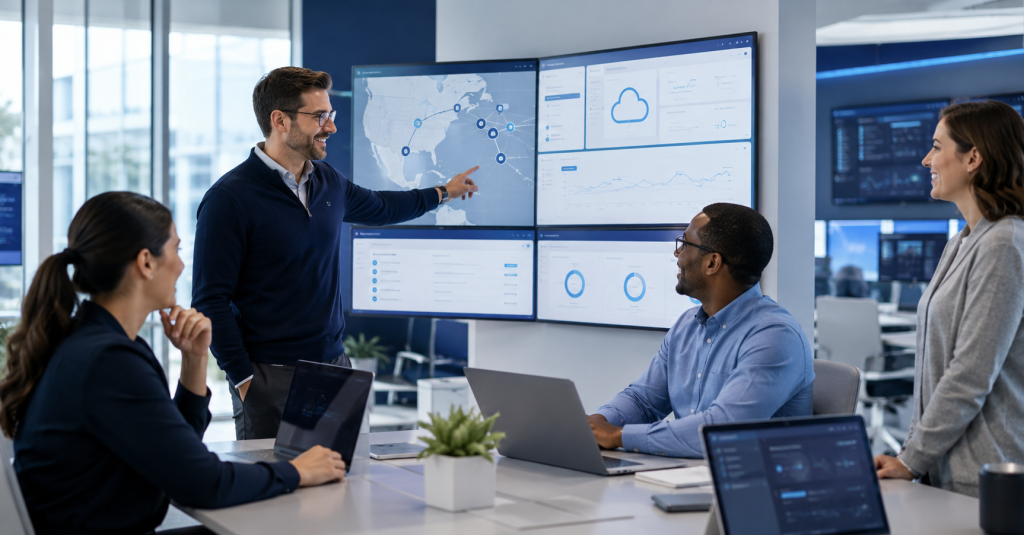
Centralized management changes that equation. Instead of treating every OOB device like an island, teams can manage infrastructure as a connected environment. They can see devices and sites in one place, control access more consistently, and maintain better visibility as the footprint grows. That is a very different buying proposition than simply comparing port counts.
This is where the OOB decision is changing. Buyers are increasingly evaluating the experience around the hardware, not just the hardware itself. How easy is deployment? Can users access the environment with credentials they already use? Can the team manage multiple sites centrally? Is cellular connectivity available when needed? Can the platform provide visibility into devices, subscriptions, and locations? Can capacity be added without starting the entire buying process over again?
And perhaps the most important question is a very simple one: does the technology make life easier for the people who actually have to use it?
Those questions may not look as exciting on a spec sheet as processor speeds or interface counts, but they often determine whether a platform becomes something your team values or something your team merely tolerates.
Nobody can predict exactly what their infrastructure will look like three years from now. Your company may open new locations, close others, move workloads, add edge infrastructure, increase cellular usage, change security requirements, consolidate tools, acquire another company, or support environments you have not even planned yet.
That is precisely why flexibility matters.
The goal is not to buy technology that somehow predicts the future. It is to choose technology that does not get in the way when the future arrives.
That is how Gearlinx approaches modern out-of-band management. The hardware is important, but it is only one part of the equation. Centralized cloud management, secure access, cellular connectivity, flexible licensing, and easier expansion all matter because infrastructure does not stand still.
So the next time you evaluate OOB, look at the ports. Read the spec sheet. Compare the hardware.
Then keep going.
Ask how you will manage it. Ask how you will scale it. Ask what happens when your environment changes.
Because the best technology decision is rarely just about what you need today. It is about how easily you can handle what comes in the future.