Remote access is only the beginning.
For years, out-of-band management had a clear and important purpose: provide an alternate way into network infrastructure when the primary network was unavailable.
When a router stopped responding, a WAN connection failed, or a configuration change caused an outage, the out-of-band connection gave the network team another path to the device. Engineers could reach the console, diagnose the problem, and begin restoring service without immediately dispatching someone to the site.
That capability is still essential. But the environment surrounding it has changed.
Infrastructure is more distributed. Network teams are responsible for more locations, devices, services, and users. Cloud environments, edge deployments, branch offices, colocation facilities, and remote sites have all expanded the operational footprint.
At the same time, expectations have increased. Organizations want faster response times, fewer truck rolls, stronger security, better visibility, and more consistent operations across every location.
Basic access can help an engineer get back into a device. Modern out-of-band management should help the entire organization recover with greater speed, visibility, and control.
What Traditional OOB Was Designed to Do
Traditional out-of-band management was built around a straightforward recovery scenario.
The primary network goes down. The engineer connects through a separate management path. The affected device becomes accessible. Troubleshooting begins.
This model solved a critical problem, especially when infrastructure was concentrated in a limited number of data centers or major facilities. Network teams knew where their equipment was located, which devices were involved, and who was responsible for each site.
In that environment, console access often provided enough information to take the next step.
Today, reaching the console remains important, but it is only one part of a much larger operational challenge.
An engineer responding to an outage may also need to know:
- Which sites and devices are affected
- Whether alternate connectivity is available
- Who has permission to access the environment
- Whether the equipment is under warranty
- Which subscriptions or licenses are active
- Whether similar issues are occurring elsewhere
- What actions have already been taken
- How quickly the site can be restored without an onsite visit
A console connection alone does not answer those questions. It provides access to a device. It does not necessarily provide visibility across the environment or the broader context required to make a fast, informed decision.
Why Access Alone Is No Longer Enough
The value of out-of-band management has traditionally been measured by whether it could provide access during an outage.
Modern network operations require a higher standard.
Teams must be able to understand what is happening, determine the scope of the issue, access the right infrastructure, and coordinate a response without moving between disconnected tools and incomplete records.
This is especially important when the same team is managing dozens, hundreds, or even thousands of remote assets.
Without centralized visibility, engineers may spend valuable time searching for device information, confirming site details, locating credentials, reviewing spreadsheets, or contacting other departments. The recovery path may be technically available, but the overall process remains slow and fragmented.
Modern OOB should help engineers move from alert to understanding and from understanding to action. It should make the recovery path easier to find, easier to manage, and easier to use securely.
That means out-of-band management must work as part of a broader operational model rather than as an isolated emergency tool.
The Rise of Cloud Management and Distributed Infrastructure
The growth of distributed infrastructure has changed the way network teams need to manage out-of-band environments.
A company may now operate a mix of corporate offices, retail locations, manufacturing facilities, edge sites, remote cabinets, data centers, and cloud-connected environments. Each site may contain different equipment, connectivity options, support requirements, and operational risks.
Managing those locations individually does not scale well.
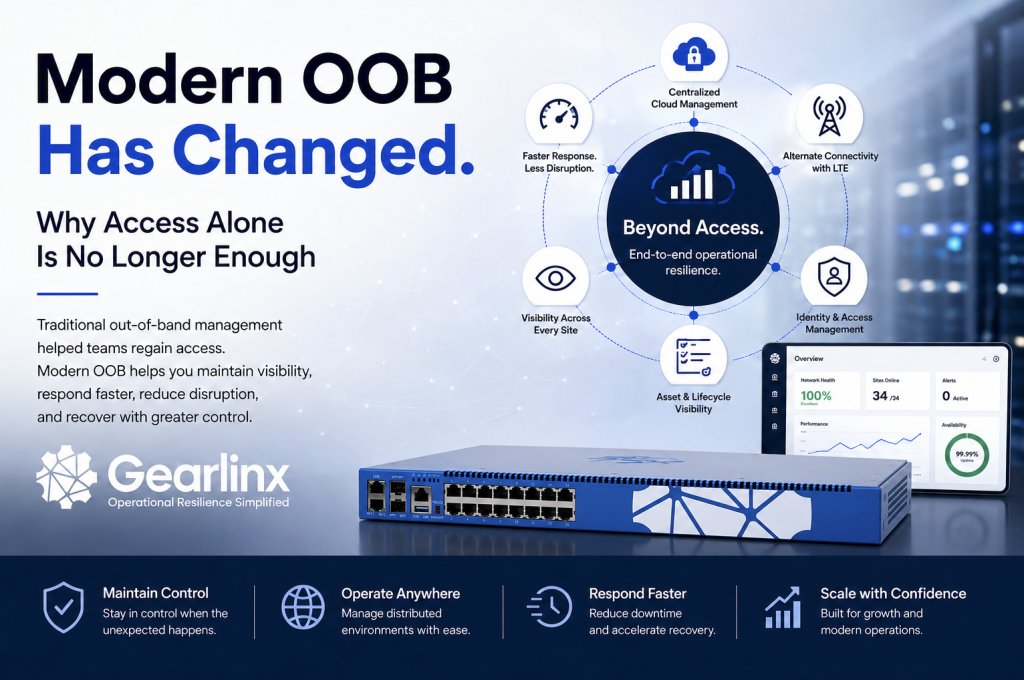
Cloud management introduces a centralized layer of visibility and control across the distributed environment. Instead of treating every OOB device as a separate box, teams can manage devices, locations, access, subscriptions, and asset information through one platform.
This changes the role of out-of-band management. It becomes more than a collection of recovery connections. It becomes part of the organization’s operational infrastructure.
With centralized cloud management, teams can gain a clearer view of:
- Network devices and their locations
- Site availability and status
- Serial numbers and asset information
- Warranty and subscription details
- User access and identity
- Alerts and operational health
- Infrastructure growth across multiple locations
This visibility matters before, during, and after an outage.
Before an outage, it helps teams understand and organize the environment. During an outage, it provides context for faster response. After an outage, it supports lifecycle management, documentation, and future planning.
Resilience Versus Simple Connectivity
Connectivity answers one question:
Can we reach the device?
Resilience asks a broader set of questions:
Can we maintain control when the primary network fails? Can we understand what is happening? Can we respond quickly? Can we recover without unnecessary disruption?
That distinction is important. A connection may technically exist, but it may not provide the visibility, alternate connectivity, centralized management, or operational context needed to restore service efficiently.
Resilience combines access with the capabilities surrounding that access.
It includes a secure and independent management path. It includes cellular connectivity when the primary WAN is unavailable. It includes centralized visibility across distributed locations. It includes identity management, lifecycle information, and a consistent way to operate the environment.
The goal is not simply to reach a device after something has gone wrong. It is to preserve operational control under difficult conditions.
This shift reflects a broader change in infrastructure strategy. Organizations recognize that not every outage can be prevented. Hardware will fail. Connectivity will be interrupted. Configuration mistakes will happen. Remote sites will become unavailable.
The real measure of readiness is how effectively the organization can respond and recover.
What Modern Teams Should Expect
Modern network teams should expect more from an out-of-band platform than console access and port counts.
They should expect secure remote access that remains available independently of the primary network, centralized management that provides visibility across sites and devices, and support for alternate connectivity, including LTE-enabled recovery paths.
They should expect a platform that produces operational readiness.
Access should integrate with the identity tools the organization already uses. Device and subscription information should be easy to find. Teams should be able to manage distributed infrastructure without relying on multiple spreadsheets or disconnected systems.
The platform should also support growth.
An OOB strategy that works for ten sites should not become unmanageable at one hundred. The management model, licensing structure, support experience, and deployment approach should all be designed for where the organization is going, not only where it is today.
Moving Beyond Basic OOB
Gearlinx was built around this broader view of out-of-band management.
Secure remote access remains foundational, but it is connected to centralized cloud management, cellular resilience, asset lifecycle visibility, identity access, and operational control.
This approach helps network teams manage the full recovery process, not just the initial connection.
Modern OOB should help engineers see more, respond faster, reduce unnecessary disruption, and maintain control across increasingly distributed environments.
Because when the network is unavailable, getting in is important. Knowing what to do next is what creates resilience.