
Fortifying a Resilient Financial Services Enterprise
The resilience of financial services infrastructure is critical to the functioning of global economies. Managing risk has never been more important as external and internal factors impacting financial services infrastructure have grown in scale and speed. Over the past 20 years, the industry has navigated through unprecedented and unpredictable events that created significant credit, market, and operational risks.
Financial institutions are heavily regulated because they lend money, issue and manage financial instruments, facilitate transactions, and provide advice to individuals and businesses. Banks, credit unions, brokerage firms, insurance companies, and mortgage companies all play a crucial role in the economy and global finance market, by providing consumers and businesses the capital and financial infrastructure to operate, access credit, and make financial transactions.
Today’s financial institutions require a more resilient operating model that has the capability to reduce risk at scale and protect the business amidst unpredictable change. This will require institutions to address new cyber risks associated with the digital expansion of financial services, an increasingly distributed workforce, and the use of the cloud for competitive differentiation.
Cybercrime and the regulatory landscape
Cyber risk is the largest and fastest growing operational risk within financial services, which has the distinction of being one of the most targeted industries by cybercriminals. In 2022 the average breach cost $4.35 million per incident. The most common attacks are data skimming from mobile devices, phishing attacks, ransomware, malware, whaling, and distributed denial of service (DDoS).
- 95 percent of cybersecurity breaches are caused by human error
- The U.S. was the target of 46 percent of cyberattacks in 2020
- Data breaches exposed 22 billion records in 2021
- Only 5 percent of companies’ folders and files are properly protected
Regulatory agencies have responded to increasing cyber risks with updated guidance for institutions and auditors. The European Union established the Digital Operational Resilience Act (DORA) to strengthen IT security for banks, insurance companies and investment firms from cyber-attacks. The Federal Financial Institutions Examination Council (FFIEC) issued an update for U.S. banks to the Architecture, Infrastructure, and Operations Examinations Handbook as well as guidance for Authentication and Access to Financial Institution Services and Systems.
Life Cycle Approach for Governing Architecture, Infrastructure, and Operations (AIO) Risk
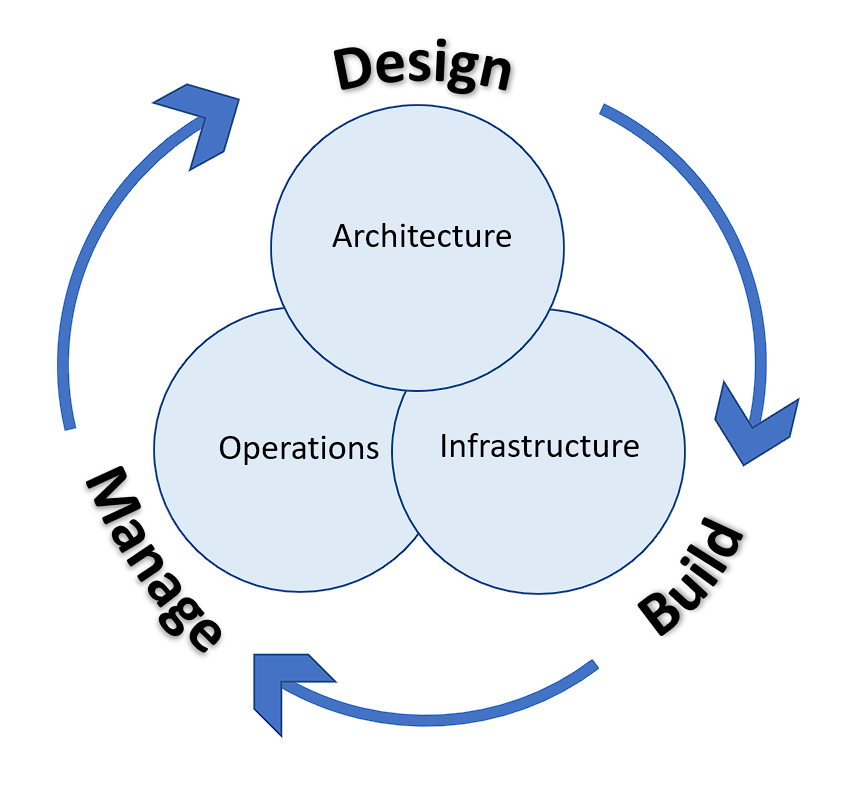
Finance IT operations management teams perform and administer the day-to-day technology operations, security, and resilience. They are responsible for managing the capacity, performance, and availability of the components used in an entity’s infrastructure, including hardware, networks and telecommunications, software, and storage.
IT operations management key network initiatives include:
- Network and connectivity for internal and external communication
- Remote access, network monitoring, and issue resolution
- Configuration management
- IT environment resilience
- Cyber and information security
IT Asset Management should have appropriate ITAM processes to track, manage, and report on the entity’s information and technology assets throughout their entire life cycle. Examples include:
- Hardware and software asset inventories
- Serial numbers, warranty information, and subscription status
- Physical location, upstream and downstream connections
- Process to address potential IT asset vulnerabilities nearing EOL
- License utilization and support costs related to maintenance of outdated versions of software and patch levels for continuity of operations
Powering Resilience for the future of digital finance
- Network resilience is essential for consistent delivery of financial services and recovery from disruptions
- Proactive monitoring and alerting to maintain availability and mitigating the risk of a disruptive network event
- Operational resilience of inventory, audit, and testing capabilities to demonstrate effectiveness

Extend Your Reach. Enhance Your Visibility. Keep Transacting.
Gearlinx™ Network Resilience Platform provides financial service companies with the reach. The Duckfone™ ensures maximum uptime with world-class 4G LTE and 5G failover. ZERO cloud-based management portal enhances your visibility.
ZERO was built from the ground up to make managing critical network infrastructure easy while maintaining Operational Resilience by simplifying management of Gearlinx™ asset subscriptions, serial numbers, and warranty information. All of it is at your fingertips to stay compliant, stay competitive, and stay ahead.
The NR4400 is a Total OOB™ NetOps Platform that creates the management network required for the network team to securely access routers, switches, firewalls, servers AND provision new network infrastructure no matter where they are located. It is convenient, secure, and essential to extend your reach and be there, without physically being there.
The Duckfone™ is a smart design for reliable and efficient cellular connectivity and failover in bank and insurance branch offices, atm machines, and kiosks. Ensure maximum uptime every day, all day.
Whether you’re in retail banking, wealth management, insurance, or financial markets, count on Gearlinx™ to help every step of the way!