Colocation Data Centers: How to Guarantee Uptime When You Don’t Control the Network
 Diana Wirth
Colocation data centers offer flexibility, scalability, and reduced capital expense, but they also introduce a fundamental operational challenge: you don’t control the facility, the upstream network, or physical access. For enterprises deploying mission-critical workloads in colocation environments, that lack of control can translate into extended downtime, SLA exposure, and costly on-site dispatches. When something goes wrong, your team may not be able to simply walk into the data hall and fix it. And when your primary network link fails, traditional remote access disappears with it.
The core issue for colo tenants isn’t just infrastructure, it’s visibility and autonomy. Shared facilities mean shared risk. Power interruptions, upstream carrier issues, misconfigured core switches, or even routine maintenance windows can isolate your equipment. If your production network is your only management path, a simple routing issue can lock you out of the very devices you need to repair. This creates a dangerous dependency on third-party hands and ticket queues, increasing Mean Time to Repair (MTTR) and putting uptime commitments at risk. In today’s hybrid and latency-sensitive environments, even short outages can impact revenue, customer experience, and compliance.
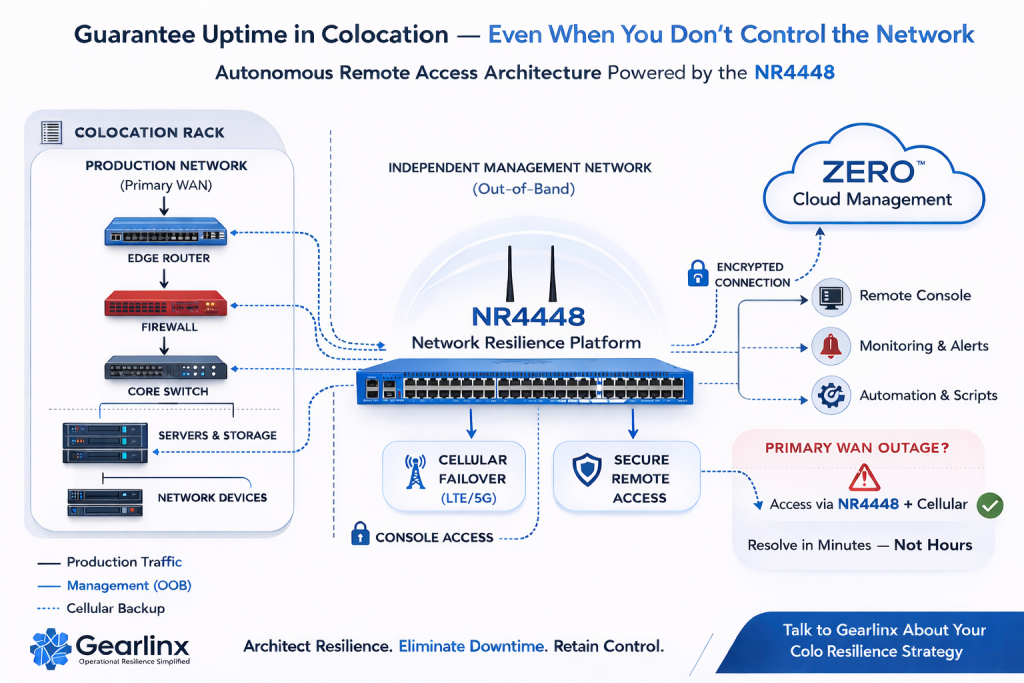
To guarantee uptime in colocation environments, organizations must architect for independence. That starts with dedicated out-of-band (OOB) management infrastructure that operates separately from the production network. By implementing autonomous remote access, including cellular failover or isolated management circuits, IT teams retain secure control of routers, firewalls, switches, and servers even during primary network outages. Remote console access, automated remediation workflows, and centralized monitoring platforms allow teams to diagnose and resolve issues without waiting for on-site support. This shift from reactive to autonomous management dramatically reduces MTTR and eliminates many truck rolls altogether.
Colocation is not inherently risky, but unmanaged dependencies are. The most resilient organizations treat colo racks as distributed edge sites: independently manageable, remotely observable, and architected for failure scenarios. By combining out-of-band access, automated monitoring, and centralized lifecycle management, enterprises can turn shared facilities into highly controlled environments. The result is stronger SLA performance, lower operational costs, and true operational resilience, even when you don’t control the building or the backbone.