Enterprise and hyperscale networks have never been more redundant, yet major outages continue to grow in both frequency and impact. According to Uptime Institute research, over 60% of significant data center outages now cost more than $100,000, and nearly one in five exceed $1 million. While these incidents are often attributed to power failures, software bugs, or human error, a less visible factor is increasingly responsible for prolonged recovery times: the loss of operational control.
For decades, resilience planning focused primarily on keeping systems running. Organizations invested heavily in redundant power supplies, clustered infrastructure, backup circuits, and geographic failover. These strategies were highly effective in traditional environments where administrators could still access infrastructure directly when something failed. If a network path went down or automation systems malfunctioned, engineers could intervene manually through local access or independent management connections.
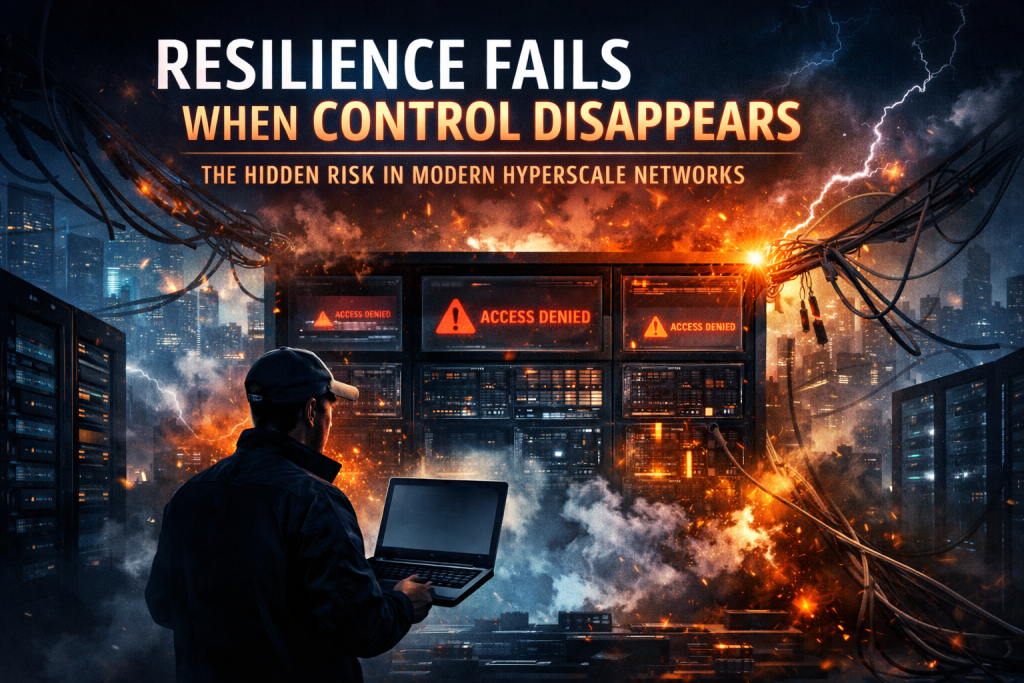
Modern infrastructure operates very differently. Today’s enterprise and hyperscale environments are deeply software-defined, highly automated, and centrally orchestrated. Identity systems, configuration platforms, and remote access tools are tightly integrated into the same operational fabric that they manage. This architectural shift has created a new and often overlooked vulnerability: when the primary network or control plane fails, the very tools required to restore service may become inaccessible.
Industry data highlights how common this scenario has become. Gartner estimates that more than 70% of unplanned downtime is now extended not by the initial failure itself, but by the time required to diagnose and remediate it. In large-scale cloud incidents over the past decade, recovery delays have frequently stemmed from administrators losing remote access to critical systems, forcing manual intervention under difficult conditions.
The challenge becomes even more severe in hyperscale environments supporting AI workloads and distributed cloud platforms. These data centers operate with extraordinary density, housing thousands of interconnected systems whose operation depends on tightly coordinated automation. If operational access pathways are disrupted, recovery becomes exponentially more complex. Physical scale limits manual intervention, system dependencies are difficult to untangle under pressure, and automated recovery tools may be impaired by the very outage they are meant to resolve.
This reality exposes a critical misconception in modern resilience planning. Redundancy ensures services can continue operating during failures, but it does not guarantee that organizations can quickly regain control when disruptions escalate. True resilience requires independent pathways that allow operators to maintain visibility and management access even when primary networks are unavailable.
This is why many forward-looking organizations are increasingly incorporating out-of-band management into their resilience strategies. By maintaining a separate, secure access channel isolated from production networks, operators can diagnose issues, restore configurations, and recover systems even during severe outages or cyber incidents. These independent control paths do not replace redundancy; they complement it by ensuring recoverability when conventional access methods fail.
As infrastructure continues to scale and automation deepens, the definition of resilience must evolve. It is no longer enough to design systems that stay online. Organizations must ensure they can retain control when systems inevitably fail. In modern networks, the most dangerous outage is not when services go down, but when the people responsible for restoring them lose the ability to reach them.